
 info@best-filtration.com
 MBR Membrane
 Reverse Osmosis Membrane
 Residential Ro Membrane
 UF Membrane
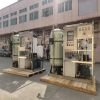 Water Treatment Plant
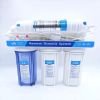 Residential Ro Machine
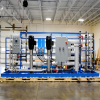 Brackish Ro System
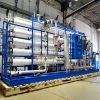 Sea water system/SW RO plant
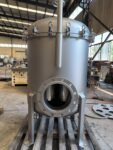 Bag Filter
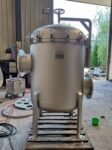 Cartridge Filter
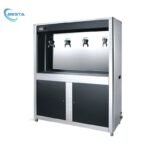 Commercial Water Filtration System
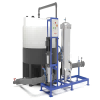 Membrane Cleaning System(CIP)
 Consumables Accessories


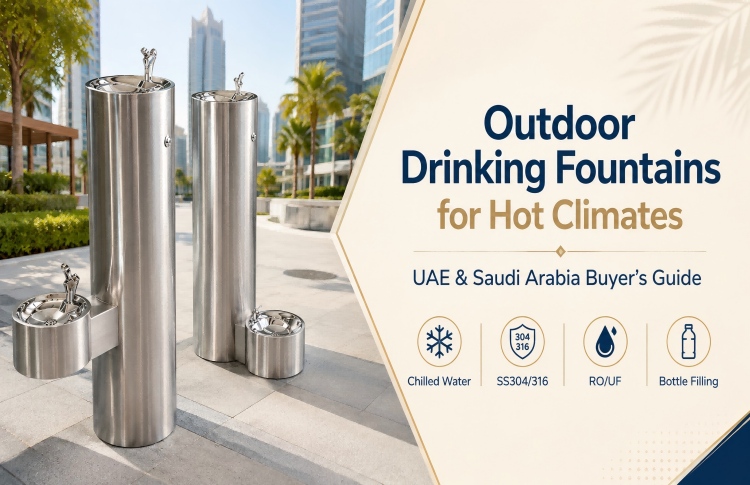
Choosing a Drinking Fountain for the Middle East Is Different
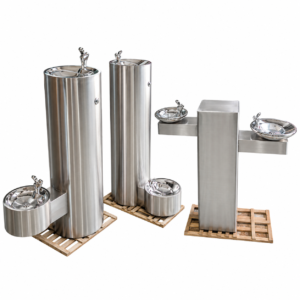
An outdoor drinking fountain installed in Dubai, Abu Dhabi, Riyadh or Jeddah operates under very different conditions from the same equipment installed in a mild climate.
High ambient temperatures, direct sunlight, dust, intensive public use and high inlet-water temperatures can all affect the performance and lifetime of a drinking water station.
For this reason, buyers in the UAE and Saudi Arabia should not select an outdoor drinking fountain based only on appearance or price.
The most important factors are:
- Cooling capacity
- Stainless steel material
- Water treatment system
- Outdoor durability
- Number of users
- Drinking and bottle-refilling functions
- Ease of maintenance
- Installation environment
This buyer’s guide explains how to select the right Middle East drinking fountain for schools, parks, sports facilities, factories, public areas and commercial projects.
1. Why Hot Climate Performance Matters
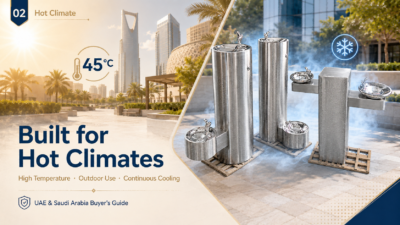
High Temperature · Outdoor Use · Continuous Cooling
Summer temperatures in Saudi Arabia can reach very high levels, while the UAE also experiences extremely hot and humid summer conditions.
A conventional indoor drinking fountain may not be designed to continuously operate under these conditions.
For an outdoor installation, buyers should therefore consider:
Ambient operating temperature
The refrigeration system, electrical components and enclosure should be suitable for high outdoor temperatures.
Inlet water temperature
If the incoming water is already warm, the cooling system needs more capacity to deliver comfortable drinking water.
Direct sunlight
Equipment installed under direct sunlight may become significantly hotter than the surrounding air.
Whenever possible, installing the station under a canopy, shade structure or covered area can improve performance and reduce energy consumption.
Peak water demand
Cooling capacity should be selected according to peak consumption rather than average consumption.
A school during break time or a factory during shift change can create much higher instantaneous demand than a public park with occasional users.
2. Chilled or Ambient Drinking Water?
One of the first decisions for a UAE or Saudi Arabia project is whether the drinking fountain requires:
Ambient Water
Ambient-water fountains are simpler and consume less electricity.
They may be suitable for:
- Indoor public areas
- Air-conditioned buildings
- Covered facilities
- Locations supplied with pre-cooled water
- Projects where refrigeration is provided separately
However, ambient water may become uncomfortable to drink in outdoor Middle East environments.
Chilled Water
For most premium outdoor projects in the UAE and Saudi Arabia, a chilled outdoor drinking fountain is usually more attractive.
It can be used in:
- Public parks
- Schools
- Sports facilities
- Outdoor gyms
- Tourist attractions
- Resorts
- Factories
- Transportation facilities
- Public recreation areas
When comparing chilled drinking fountains, do not ask only:
“Does it have a chiller?”
Ask:
“How many litres of chilled water can the unit continuously produce per hour under our actual ambient and inlet-water conditions?”
This is a much more useful specification.
3. How Much Cooling Capacity Do You Need?
Cooling capacity should be selected according to the number of users and expected peak demand.
As a general project-selection concept:
| Application | Typical Demand Level | Suggested Configuration |
| Small office / private area | Low | Single-station fountain |
| Small school area | Medium | 2-user chilled fountain |
| Public park | Medium–High | 2–4 user station |
| Large school | High | Multi-user drinking station |
| Factory / worker facility | High | High-capacity chilled station |
| Stadium / sports facility | Very High | Multiple stations or centralized cooling |
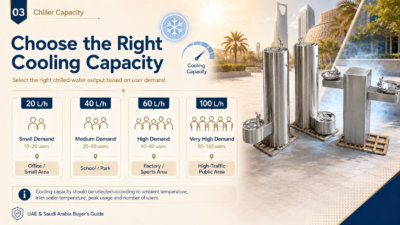
The actual refrigeration capacity should be calculated according to:
- Number of users
- Water consumption per person
- Peak usage period
- Required outlet temperature
- Inlet water temperature
- Ambient temperature
- Recovery time
For large projects, using several drinking points connected to a centralized chilled-water or filtration system may be more efficient than installing an individual cooling system inside every fountain.
4. SS304 or SS316: Which Material Is Better?
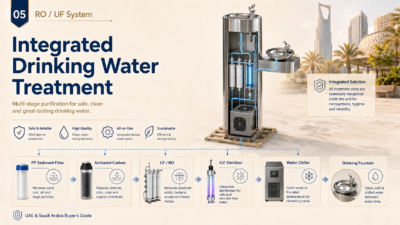
Integrated Drinking Water Treatment
Stainless steel is one of the best materials for outdoor public drinking fountains because it is hygienic, durable and easy to clean.
Two common options are:
SS304 Stainless Steel
SS304 is suitable for many general applications, including:
- Schools
- Factories
- Indoor public areas
- Covered outdoor locations
- Parks away from highly corrosive environments
It normally provides a good balance between performance and cost.
SS316 Stainless Steel
For more demanding environments, SS316 may be preferred.
Typical applications include:
- Coastal areas
- Beach projects
- Marine environments
- Resorts near the sea
- Locations exposed to saline air
- Premium municipal projects
This is particularly relevant to coastal cities such as Dubai, Abu Dhabi, Jeddah and other Gulf locations.
For many Middle East projects, offering both SS304 and SS316 outdoor drinking fountains allows contractors to select the appropriate material according to the project specification.
5. Should the Drinking Fountain Include Water Filtration?
Not every drinking fountain requires the same filtration system.
The correct treatment process should depend on the incoming water quality.
Integrated Drinking Water Treatment
Option 1: Activated Carbon
Activated carbon can help improve:
- Taste
- Odour
- Residual chlorine
It is often used as part of a drinking-water polishing system.
Option 2: UF Ultrafiltration
UF membrane filtration can provide an additional physical barrier for fine suspended particles and microorganisms.
A typical configuration may include:
Sediment Filter → Activated Carbon → UF → Drinking Fountain
UF can be suitable when the incoming water already has acceptable dissolved-salt levels.
Option 3: RO Reverse Osmosis
RO may be considered when reduction of dissolved salts or other dissolved contaminants is required.
A typical configuration may be:
Pretreatment → RO → Storage Tank → UV → Chiller → Drinking Fountain
The decision between RO and UF should always be based on actual feed-water analysis and the required drinking-water quality.
For large UAE and Saudi Arabian projects, integrating the filtration system with the drinking station can provide a complete drinking-water solution rather than simply supplying a stainless-steel fountain.
6. Bottle Filling Is Becoming Increasingly Important
Traditional drinking fountains are designed primarily for direct drinking.
Modern public projects increasingly combine:
Drinking Fountain + Bottle Filling Station
This allows users to:
- Drink directly
- Refill reusable bottles
- Reduce disposable plastic bottles
- Carry drinking water while exercising or travelling
Dubai is already developing public refill infrastructure in parks, beaches, tourist destinations and other high-traffic locations through citywide refill initiatives.
For municipal, tourism and sustainability projects, a bottle filling station can therefore be an important specification.
Possible configurations include:
- Drinking fountain only
- Bottle filler only
- Drinking fountain + bottle filler
- Multi-user drinking station + bottle refill point
7. Choose the Correct Height for Different Users
Not every drinking fountain should have the same height.
Projects may require facilities for:
Adults
Standard-height drinking stations are suitable for most commercial and industrial locations.
Children
Schools, playgrounds and family parks may require lower drinking points.
Wheelchair Users
Public projects may also require accessible drinking points at a lower height.
A practical solution is a:
High-Low Drinking Fountain
This design provides two different drinking heights on the same unit.
It is especially suitable for:
- Schools
- Public parks
- Hospitals
- Transportation facilities
- Government buildings
- Family recreation areas
Exact accessibility dimensions should always follow the standards required by the destination country and project consultant.
8. Outdoor Durability Is More Than Stainless Steel
A good drinking fountain for hot climate applications should be designed as a complete outdoor product.
Buyers should check:
Corrosion Resistance
Consider stainless steel grade, fasteners, internal pipework and surface finishing.
UV Resistance
Painted or powder-coated models should use finishes suitable for prolonged outdoor exposure.
Electrical Protection
If the unit contains a chiller, UV system, pump or electronic bottle-filling sensor, electrical components must be protected for the intended installation environment.
Ventilation
Refrigerated models need adequate airflow around the condenser.
Poor ventilation can significantly affect cooling performance.
Drainage
Outdoor stations should have reliable drainage to prevent standing water around the equipment.
Vandal Resistance
For unattended public areas, consider:
- Heavy-duty stainless steel construction
- Protected plumbing
- Anti-tamper fasteners
- Durable faucets
- Limited exposed components
These features are particularly valuable for parks, schools, transport hubs and other high-traffic locations.
9. Where Are Outdoor Drinking Fountains Used in UAE and Saudi Arabia?
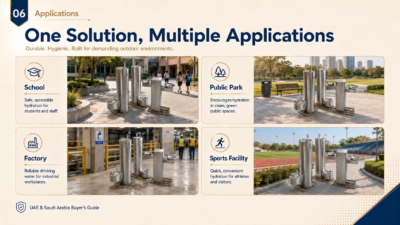
One Solution, Multiple Applications
The main applications include:
Schools and Universities
Recommended features:
- High-low design
- Multiple drinking points
- Chilled water
- Bottle filling
- Optional filtration
Public Parks
Recommended features:
- Stainless steel
- Vandal-resistant construction
- Chilled water
- Bottle filling
- Outdoor-rated components
Sports Facilities
Recommended features:
- High flow rate
- Large cooling capacity
- Multiple users
- Bottle filling
Factories and Industrial Facilities
Recommended features:
- High-capacity water supply
- Multiple drinking points
- Easy maintenance
- Optional centralized RO or UF system
Hotels and Resorts
Recommended features:
- Premium appearance
- SS316 option
- Chilled water
- Bottle refill
- Integrated filtration
Public and Municipal Projects
Recommended features:
- Heavy-duty structure
- Customized appearance
- Accessible design
- High reliability
- Easy spare-part replacement
10. Questions to Ask Before Requesting a Quotation
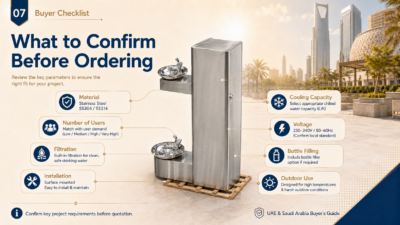
What to Confirm Before Ordering
Before contacting an outdoor drinking fountain supplier in UAE or Saudi Arabia, prepare the following information:
- Installation country and city
- Indoor or outdoor installation
- Number of expected users
- Number of drinking points
- Chilled or ambient water
- Required chilled-water capacity
- SS304 or SS316 construction
- Drinking fountain or bottle filling
- Incoming water quality
- RO, UF, carbon filtration or no filtration
- Available power supply
- Required outlet water quality
- Installation dimensions
- Accessibility requirements
- Logo or colour customization
- Quantity required
Providing this information allows the manufacturer to recommend a much more accurate solution.
What Is the Best Outdoor Drinking Fountain for UAE and Saudi Arabia?
There is no single model that is suitable for every Middle East project.
For schools and public parks, a high-low chilled drinking fountain with bottle filling may be a practical choice.
For factories and large facilities, a multi-user high-capacity drinking water station may be more appropriate.
For coastal projects, SS316 stainless steel can provide additional corrosion resistance.
For projects requiring additional water treatment, the drinking station can be integrated with:
RO + UV + Chiller
or
Carbon + UF + UV + Chiller
depending on the incoming water quality.
The most important principle is to select the fountain as part of the complete drinking-water system rather than treating it only as a piece of outdoor furniture.
Looking for an Outdoor Drinking Fountain for Your UAE or Saudi Arabia Project?
We supply customized outdoor drinking water stations for schools, parks, factories, sports facilities, hotels and public projects.
Available options include:
- SS304 / SS316
- Single or multi-user designs
- High-low drinking fountains
- Chilled drinking water
- Bottle filling stations
- RO / UF filtration
- UV sterilization
- Customized colours
- OEM branding
- Project-based configurations
