info@best-filtration.com
 MBR Membrane
 Reverse Osmosis Membrane
 Residential Ro Membrane
 UF Membrane
 Water Treatment Plant
 Residential Ro Machine
 Brackish Ro System
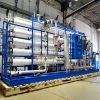 Sea water system/SW RO plant
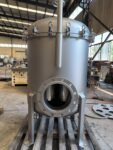 Bag Filter
 Cartridge Filter
 Commercial Water Filtration System
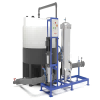 Membrane Cleaning System(CIP)
 Consumables Accessories


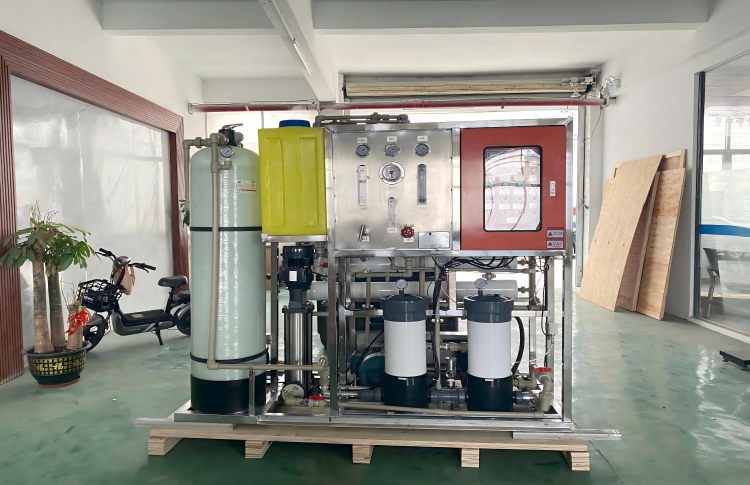
Access to clean drinking water while at sea has always been a critical challenge for shipping and maritime operations. With no natural freshwater sources available in the open ocean, ships must rely on innovative technology to ensure that their crew and passengers have safe, potable water. One of the most reliable and efficient solutions is the dual-stage reverse osmosis (RO) seawater desalination system. This technology transforms seawater into clean, drinkable water that meets strict potable water standards.
The Challenge of Seawater
Seawater contains high concentrations of salts, minerals, and other impurities. Drinking seawater directly is not safe due to its high salinity, which can cause dehydration and other health risks. Additionally, seawater may contain microorganisms and dissolved solids that are harmful if ingested. Therefore, removing these contaminants effectively is essential for onboard water supply.
What is Dual-Stage Reverse Osmosis?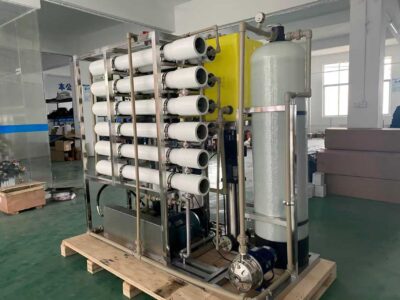
Reverse osmosis is a water purification process that forces water through a semi-permeable membrane, leaving salts, bacteria, and other impurities behind. While a single-stage RO system can reduce salinity to some extent, dual-stage RO provides a higher degree of purification, making the water safe for direct consumption.
A dual-stage RO system works in two main steps:
-
First-Stage Filtration: Seawater is pumped through the first RO membrane, which removes the majority of salts and impurities. At this stage, a significant portion of the dissolved solids is filtered out, but some residual salts may remain.
-
Second-Stage Filtration: The partially treated water passes through a second RO membrane for further purification. This stage ensures that the water meets stringent drinking water standards, providing clean, safe, and fresh water suitable for human consumption.
Advantages of Dual-Stage RO on Ships
-
High Purity Water: Dual-stage RO significantly reduces salt content and contaminants, producing water that is comparable to bottled drinking water in quality.
-
Continuous Water Supply: These systems can produce water 24/7, providing a reliable freshwater source for ships on long voyages.
-
Compact and Efficient: Modern dual-stage RO desalination units are designed to be compact and energy-efficient, making them suitable for limited onboard space.
-
Low Maintenance: With proper pre-treatment and maintenance, dual-stage RO systems can operate reliably for years with minimal intervention.
-
Adaptable Flow Rates: Depending on the ship’s needs, these systems can handle varying capacities, from a few cubic meters per hour for small vessels to hundreds of cubic meters for large ships.
How It Works in Practice
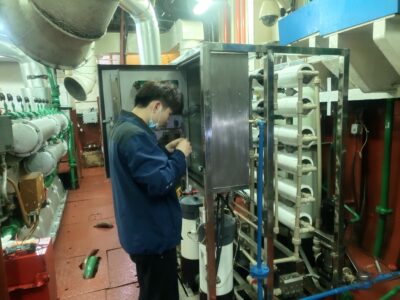
On a typical ship, seawater is drawn into the desalination system through an intake. The water is first pre-treated to remove larger particles, sediments, and chlorine that could damage the RO membranes. Then, the water enters the first-stage RO module, where most salts and impurities are removed. After that, the partially purified water goes through the second-stage RO module, resulting in high-quality drinking water.
The final water is stored in onboard tanks, ready for use in drinking, cooking, and hygiene. Some systems also include post-treatment options, such as UV sterilization or mineral adjustment, to improve taste and ensure safety.
Environmental Considerations
Dual-stage RO desalination is also designed with environmental impact in mind. While the process generates concentrated brine, modern systems incorporate strategies to disperse it safely, minimizing effects on marine life. This allows ships to maintain a sustainable freshwater supply without harming the surrounding ecosystem.
Applications Beyond Shipping
Although primarily used on ships, dual-stage RO systems are also applicable to coastal platforms, yachts, and remote islands, where access to clean water is limited. They provide a dependable solution wherever seawater is abundant but freshwater is scarce.
Conclusion
Ensuring a safe, continuous supply of drinking water at sea is vital for maritime operations. Dual-stage reverse osmosis desalination systems provide a proven, efficient, and reliable method to convert seawater into fresh, potable water. With high purification efficiency, compact design, and adaptability, these systems are indispensable for modern shipping vessels, guaranteeing that crews and passengers always have access to safe drinking water, even in the middle of the ocean.